Hill of Ammunition
גבעת התחמושת
About
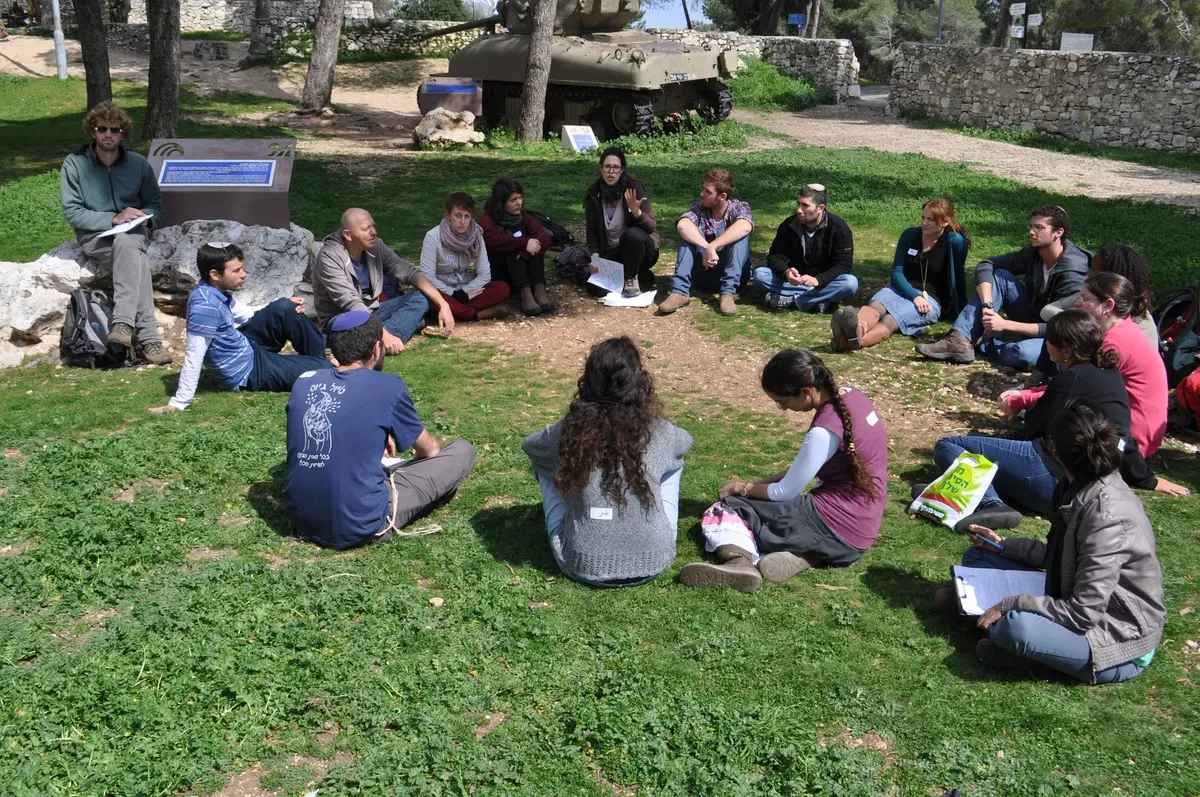
All the information about Givat Hatahmoshet at the beginning of the 1930s, during the Mandate period, the British built a "police officers' school" in the north of Jerusalem (today within the Maalot Dafna neighborhood). The ammunition stored in the nearby hill gave it the name "Givat Hatahmoshet." During the War of Independence, on 19/5/48, the Jordanians captured parts of the northern area of Jerusalem, including the police officers' school and Givat Hatahmoshet. As a result of the War of Independence, Jerusalem was divided for 19 years into two separate cities—Israeli and Jordanian. Between the two parts of the split city, a border line called the "Municipal Line" ran from Givat Hatahmoshet in the north to the Mar Elias monastery in the south of Jerusalem. Along it, barbed-wire fences were laid with mines buried and military positions built. The Old City remained under Jordanian control. Mount Scopus became an Israeli enclave, guarded by 120 IDF soldiers dressed as police officers. Every two weeks, half the force stationed on the hill was replaced with the help of the "biweekly convoy." To prevent Israel from linking up with the Mount Scopus enclave and thereby disconnecting the East Jerusalem–Ramallah road, the Jordanians built three fortified outposts: the police officers' school–Givat Hatahmoshet compound, the Givat Hamevater outpost, and the French Hill outpost. A reinforced Jordanian infantry company (about 150 fighters) from the Al-Hussein battalion defended the police officers' school–Givat Hatahmoshet compound. The Battle of the Six Days began on the morning of 5 June 1967. Diplomatic efforts by Israel to avoid war with the Jordanians failed. King Hussein of Jordan ordered his army to open fire along the Municipal Line. The Central Command in Jerusalem and its surroundings had 3 reserve brigades, aided by an artillery battalion, a command armor battalion (Gash"p), and the air force. The Jerusalem Brigade (16) halted a Jordanian attack in the south of the city and captured the area of Armon HaNatziv—the "Pa'amon" outpost—while cutting the East Jerusalem–Bethlehem road. The Harel Armor Brigade (10) operated from the northwest of the city toward the Nabi Samuel ridge, cutting the Jerusalem–Ramallah axis. The Paratroopers Brigade (55) was supposed to operate on the Egyptian front, but since IDF forces advanced rapidly there, the paratroopers were diverted at the last moment to Jerusalem. The brigade was tasked with breaching the Municipal Line in northern Jerusalem in order to create a base for linking up with Mount Scopus and freeing the Old City. On the night of 5/6 June 1967, battalions 28 and 71 broke through the Municipal Line in the area of Nahalat Shimon. Battalion 66 broke through the Municipal Line opposite the police officers' school. A fierce battle was fought on Givat Hatahmoshet. On the morning of 7/6/67, IDF soldiers captured the Old City. Motta Gur, commander of the Paratroopers Brigade, reported: "The Temple Mount is in our hands"—the divided city was reunited. At the end of the war, once the fighting of the Six-Day War (1967) subsided, there was a push to establish a Jewish outpost in the unified city. As a first step, the Israeli government decided to build a residential neighborhood on the exposed rocky hills, near the former border line, in the northeast of Jerusalem. A few days after the city was liberated, bulldozers began to nibble at Givat Hamevater in order to prepare it for housing, according to a plan for accelerated construction on Givat Hatahmoshet, the battlefield from which the IDF broke into the city. When Yossi Yafe (may his memory be blessed), commander of battalion 66 of the Paratroopers Brigade (55), learned that they were going to demolish Givat Hatahmoshet, he turned to Yitzhak Paniger, father of Ofar (the last casualty on the hill), and asked for his help to prevent the demolition. Paniger hurried to contact several bereaved parents, and together they planned to place guards by day and by night on the battlefield where the fresh imprint of the war was still visible in its trenches. The intervention of the bereaved parents, and their firm demand to keep the site of the battle and release it for future generations—this is what led to its transformation into a memorial site. The feelings of the bereaved parents were understood. Paniger, who became the first CEO, proposed to establish a site that would commemorate three things: the great event in the life of the nation, and the very liberation of Jerusalem by the IDF brigades that took part in this battle; to commemorate the memory of the 182 heroes who risked their lives and fell in the liberation of Jerusalem in the Six-Day War; and to commemorate the cultural, artistic, and literary legacies of those who left these legacies to us and did not have time to complete them. The committee devoted seven years to organizing the plan. A special committee was also established to create the site, and people who were connected to the liberation of the city in the Six-Day War were added to it. Aluf (ret.) Uzi Narkiss (may his memory be blessed) was chosen as the first chairman of the association. At the center of the hill, a monument was erected bearing the names of the fallen of battalion 66: in the battle to breach the border line—the Municipal Line—capture the police officers' school and Givat Hatahmoshet. Due to the importance of the hill, it was decided to declare it a central site for all the brigades that took part in the battle for the unification of Jerusalem. In 1972, on the fifth anniversary of the liberation of Jerusalem, 182 olive trees were planted on the hill in memory of the fallen. In 1975, on the eighth anniversary of the liberation of Jerusalem, the site was inaugurated. The site is located opposite the hill that cuts between the PaGe"Y homes and the university buildings. The atmosphere since the war has changed: instead of the noise of explosions and shouting, there is the rustling of pine trees; the battlefield is covered with lawns; and instead of fighters, children play there. Trenches and battle areas have become fields for play and study. From Maromim, the new Jerusalem can be seen. Nearby, across the road, are the homes of Ramat Eshkol, and beyond them the residential towers of the Ramot neighborhood and the rocky ridge of Nabi Samuel. On the road leading toward Shechem are the homes of the French Hill and the university on Mount Scopus. At the center of the hill is a museum telling the stories of the campaign for Jerusalem. Opening hours: Sundays–Thursdays: 9:00–17:00; Fridays: 9:00–13:00 In a large parking area and public garden with picnic facilities and public restrooms.
Tags
More activities in Jérusalem
Need help planning your activities?
Our French-speaking team helps you plan your stay in Israel, with personal advice, reservations and transfers.