The Western Wall – A Guide for Worshipers and Travelers
הכותל המערבי - המדריך למתפלל ולמטייל
About
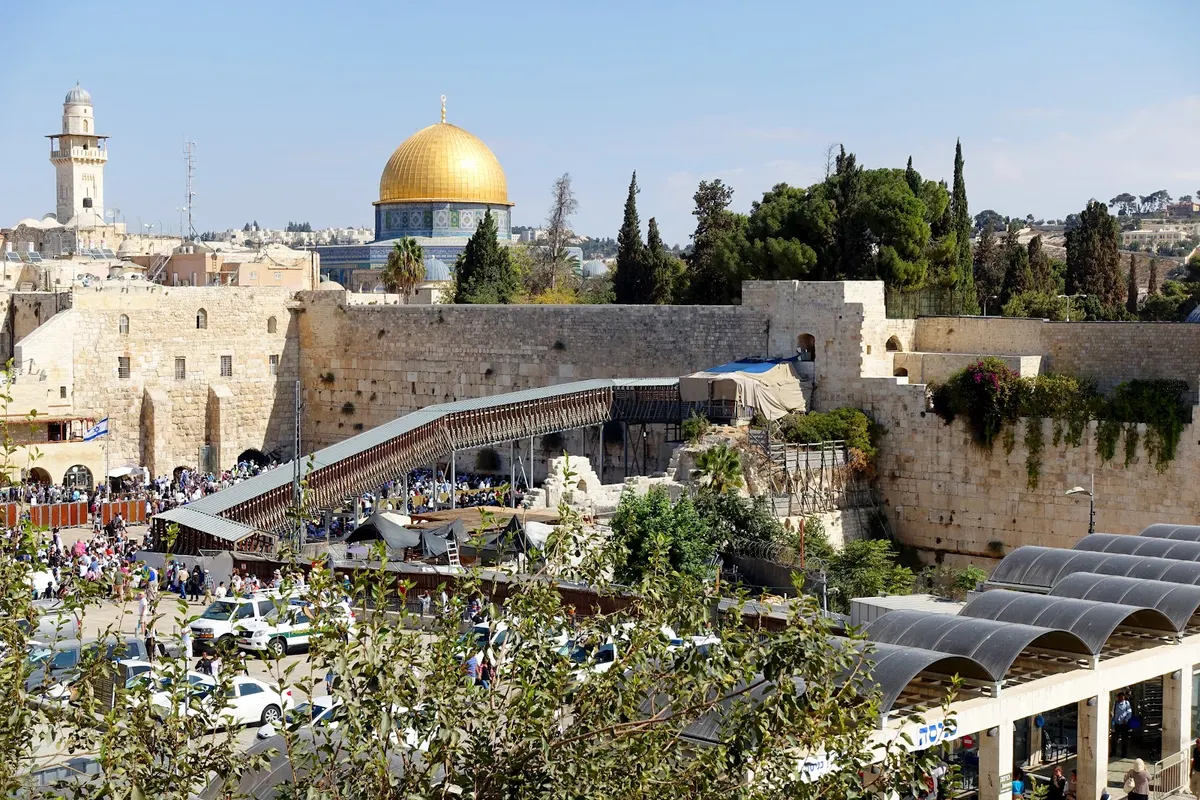
All the information about the Western Wall - the guide for worshippers and travelers. The Western Wall was part of the western retaining wall above which the Temple Courtyard was built by King Herod. After the destruction of the Second Temple in 70 CE, by the Roman commander Titus, the Wall remained as a remnant of the splendid structure that had stood there beforehand. When it was forbidden for Jews to pray on the Courtyard, they came to the Western Wall, which is the closest point to the Holy of Holies, the most important place in the Temple. Its spiritual and physical significance placed the Western Wall at the heart of the Jewish people. At the same time, research, legends, and of course the prayers surrounding the Wall have never come to an end. Come and discover the secrets of the wall, in which we all put a note. The story of the Western Wall: time stood still - seeing the Wall as on the Day of Destruction. The small wall - a place not everyone knows. A spiritual experience - when is the best time to visit the Wall? Rules of conduct for visitors to the Western Wall. Legends and stories about the Western Wall. The story of the Western Wall: toward the end of the first century BCE, Herod began building the Second Temple. Architecturally, the Temple was considered the peak of grandeur and beauty, as only Herod knew how to build. First, the Temple Mount Courtyard was bordered by four massive supporting walls, and the interior of the compound was filled with earth. In the center of the courtyard stood the Temple. The Western Wall, as we know it today, serves along a length of 60 meters and its original height reaches about 30 meters (most of it is underground). The total length of the Western retaining wall is 458 meters, the longest of them all. It begins at the southwestern corner of the Temple Mount, in the place where the Davidson Archaeological Garden is today, and continues to the northwestern corner located in the Muslim Quarter. From the Prayer Plaza area and northward, the Wall runs through what is now known as the Western Wall tunnels—tunnels extending beneath and along the remains of the Western Wall, under the Muslim Quarter. Time stood still - seeing the Wall as on the Day of Destruction, in the days of the Second Temple. From the southwestern corner of the Wall, Robinson's Arch once stood. The arch was part of what is considered to this day to be the first interchange in the world, and on it a stairway was built that was used by those ascending to the Temple Mount. Under the arch, next to the Western Wall, a street and everyday life took place. So how exactly can you see that same arch? Well, the arch did not survive intact, but part of it can be seen right after entering through the Dung Gate. A few meters after passing through security screening, pause and look to the right toward the Davidson Archaeological Garden. Right under the upper edge, at the southwestern corner of the Wall, you can make out part of the arch. An even better option is to visit Davidson Center (for a fee) and be exposed to the remains of the destruction—almost as if the Romans had left Jerusalem just a few days ago. In addition, you can see a reconstruction of the arch, the spot where the shofar would be sounded at the Wall, and learn how those huge and heavy stones were raised. The visit to the garden is fascinating and educational. For visitors at Davidson Center: Opening hours: Sun-Thu 8:00-17:00. Friday and eve of holidays 8:00-14:00. Address: Maleshot Har Shlomo Goren, near the Dung Gate. Prices: Adult - 30 NIS. Child, student, soldier, pensioner - 16 NIS. Guided tour cost ranges between 160-250 NIS and is limited to 35 people per group (the tour must be arranged in advance). For scheduling and additional inquiries by phone: 02-6277550. With the passage of time, in the years after the destruction, the Jews were expelled from Jerusalem. During the period when the Land of Israel was under Byzantine rule, the Temple Mount was neglected and became a dumping ground. With the Muslim conquest in the 7th century CE, the Temple Mount complex was exposed; the Dome of the Rock was built and later the Al-Aqsa Mosque. The Western Wall was far beyond the reach of the Jews. Even during the renewed settlement of the Jewish Quarter in the 13th century by Ramban, there were few indications that the Wall was a place of prayer. The turning point came in the 16th century, during Ottoman rule in the country, when the Turks invited Jews to settle in the sacred cities. At this stage, many Jews began to visit the Western Wall, and the descriptions indicate that the single remnant of the Temple complex (the Wall) became a well-known, sacred, and symbolic place for the Jewish people in the Land and the Diaspora—one that people make a pilgrimage to. Despite free access to the Wall compound, at times worshippers had to bribe the residents of the Mughrabi neighborhood that sat nearby the wall. When standing facing the Wall, you can see right above the Women's Area, on the right, the ramp by which one ascends to the Temple Mount Courtyard. This is the Mughrabi access, and today it is the only route through which Jews can enter and visit the Temple Mount. For those interested in a day tour in the Old City, it is recommended to start with a visit to the Temple Mount (early in the morning), then head to the Western Wall plaza and ascend for a tour of the Jewish Quarter, which also includes lunch. Route in the Muslim Quarter and the Temple Mount >> Route in the Jewish Quarter >> The small Western Wall - a place not everyone knows. Unlike what we know today as the Prayer Plaza, the first worshippers tucked their note into the Wall, which is 28 meters long, and the width of the plaza where they stood did not exceed 4 meters. South of today's Western Wall plaza, within the Muslim Quarter, is the Small Wall. It is not only a prayer area but also a reminder of how crowded the central Western Wall plaza was before the Six-Day War. To reach the Small Wall: from the Western Wall plaza, go to HaGai Street, then turn right onto Sha'ar HaBarzel Street. A few meters before the gate, turn left, and you will be at the Small Wall. Let's continue telling the story of the Wall. Restrictions on placing chairs, benches, partitions, and even sounding the shofar made it very difficult for Jewish worshippers. Even in 1840, the Western Wall plaza was declared a waqf (a Muslim religious endowment). This tension between the religions was the basis for violent events that affected the community nearly a century later. In 1929, the riots of the "Terpa't" (Hebron riots) broke out, prompted by a complaint from the Mughrabi residents about a partition placed in the Western Wall plaza on Yom Kippur. The events escalated into violence, desecration of the Wall, and the destruction of sacred books by Arab rioters. As a result, the British Mandate government limited the freedom of Jewish worship at the site. In response to the Arab unrest, a group of Jewish youths organized, known as the "Plugat HaKotel" (Western Wall Platoon). They worked to disrupt the British orders, and on the day of the Partition decision, November 29, 1947 (29 Kislev), they prayed at the Wall with about 1,500 people. From that day onward, Jews could no longer pray or touch the Wall until the liberation of Jerusalem on the night of June 7, 1967 by the paratroopers' forces. From that year onward, the Western Wall plaza was prepared to accommodate worshippers. The Mughrabi neighborhood was evacuated from the area, and archaeological excavations revealed the existence of the upper city from the Second Temple period in the days before the destruction. Since (1967) and to this day, the prayer plaza has been staffed with worshippers all hours of the day. Apart from prayers on Shabbat, holidays, and festivals, the Western Wall plaza today is also used for ceremonies such as the swearing-in of soldiers. On Mondays and Thursdays, Bar Mitzvah celebrants are customary to come up and enter the Wall with drums and dances. A spiritual experience - when is the best time to visit the Wall? Throughout the year there are several must-see dates and days that, at least once in a lifetime, should have you present at the Wall. It is a sight that you cannot stay indifferent to. Thousands of worshippers gather before the sacred wall: blessing, crying, wishing, waiting, dancing—everything depends on the occasion. On Tisha Be'Av, the day of the destruction of the First and Second Temples—thousands of worshippers come to the plaza. Tisha Be'Av is a day of fasting in Judaism, and on the eve of the fast people recite lamentations and read the Book of Lamentations (Megillat Eicha). It is also customary to sit on the plaza floor rather than on a chair as is done during official mourning. On 10 Tishrei, Erev Yom Kippur—an evening of forgiveness and atonement, on which the Holy One, blessed be He, forgives us for our sins. The release of vows is performed, and during Yom Kippur special prayers are recited, including "Kol Nidrei." At the end of the holiday, the shofar is sounded, symbolizing the closing of the gates of heaven and giving the sign that it is permitted to eat. The month of Elul, the month of forgiveness—by virtue of being the last month of the previous Hebrew year. The month of Elul is dedicated to saying selichot (forgiveness prayers) and to personal accounting between a person and themself, between a person and another, and between a person and God. The recitation of selichot continues throughout the entire month of Elul. A visit to the Wall on one of the evenings of a holiday is a special and emotional experience, but throughout the month the atmosphere is felt across the entire Jewish Quarter and even through the narrow alleys of the Nachlaot neighborhood west of the Old City. More about a tour route in Nachlaot >> The Priestly Blessing, Chol HaMoed Sukkot, 15-21 Tishrei. Sukkot is one of the three pilgrimage festivals (Passover, Shavuot, Sukkot). Besides the shared purpose of all these holidays—reminding us of the Exodus from Egypt, the receiving of the Torah, and the temporary dwelling in the sukkah—each holiday has an additional unique goal. Sukkot is a holiday for the entire people, and the mitzvah is to rejoice. Moreover, the mitzvah of the Four Species, on which blessings are recited, in fact expresses all the layers of the people. According to the Torah, on this day the priests are commanded to bless the entire Jewish people. In our days, during Chol HaMoed Sukkot thousands of priests gather, and the Priestly Blessing is heard throughout Jerusalem. 28 Iyar, Jerusalem Day—a day commemorating the liberation and unification of Jerusalem. Apart from state ceremonies, on this day there is a large march accompanied by the waving of Israeli flags and dancing. The march ends at the Western Wall plaza, where the day is sealed, and crowds dance, sing, and celebrate in circles. Rejoice and be glad, as they say. Rules of conduct for visitors to the Western Wall. The Western Wall is a sacred place, and the following rules apply to visitors: You must arrive in modest, appropriate clothing that respects the place. Women may be required to add additional covering during the visit to the Western Wall plaza. Entry to the Western Wall compound is conditional upon security screening. Do not come with sharp objects that could be used as weapons. On Shabbat and holidays—it is forbidden to photograph, smoke, or talk on a mobile phone. Entry with animals is prohibited. Do not enter with musical instruments. Bar Mitzvah celebrants will be accompanied up to the entry gate. Do not smoke or light candles near the Wall. Legends and stories about the Western Wall A decision by the emperor: it was not by chance that the Western Wall survived the destruction inflicted upon it by Vespasian, the Roman emperor. After the fighting ended and the Temple and Jerusalem were destroyed, Titus's soldiers wondered why his father had ordered that the Western Wall not be destroyed. Vespasian's reply was: "If I had not left the Wall standing, who would have believed me about this great act and victory over the Jews?" Your city's poor first: when God commanded Solomon to build a permanent dwelling for Him, the First Temple, He instructed that the entire people participate in its construction, and so it was. The city's well-off and influential figures built the eastern wall; the men and the affluent built the northern and southern walls; while the poor were the ones who merited building the Western Wall. Whereas the three walls built by the rich and affluent were completed quickly with paid laborers, the Western Wall was built slowly, because the poor had to carry the stones themselves—stones they quarried from Zedekiah's Cave, north of the Temple Mount. When God "descended" to establish His Presence in the Temple, He looked favorably at the wall of the poor and proclaimed: "This wall will never be destroyed." Thus, the Presence rested among the stones of the Wall that have survived to this day. The legend of the Sultan: in 1517 Ottoman rule began in the country. At that time, the residence of the Turkish sultan was adjacent to the Chain Gate located in the western part of the Temple Mount. One day, the Sultan caught sight, out of the corner of his eye, of an elderly woman of about 90 throwing her household trash near his house. The ruler became furious and summoned the old woman for questioning. The Sultan asked her where the audacity for such an act came from. The old woman replied that even during Roman rule, in the days after the destruction, the emperor had ordered the non-Jewish residents of Jerusalem to dump their household waste in that very place. Those who lived nearby would do it once a day; those farther away would do it every two days; and everyone else would do it once a month. Why? the Sultan wondered and asked the old woman. She answered: "Because it is a divine place of the people of Israel." Upon hearing this, the Sultan hid gold coins among the heaps of trash that had wrapped the walls of the Temple Mount. The residents of the city came in large numbers to search for the gold coins. And, unwillingly, they were forced to clear away the trash in order to find the coins. In this way, the place became clean and shining.
Tags
More activities in Jérusalem
Need help planning your activities?
Our French-speaking team helps you plan your stay in Israel, with personal advice, reservations and transfers.